
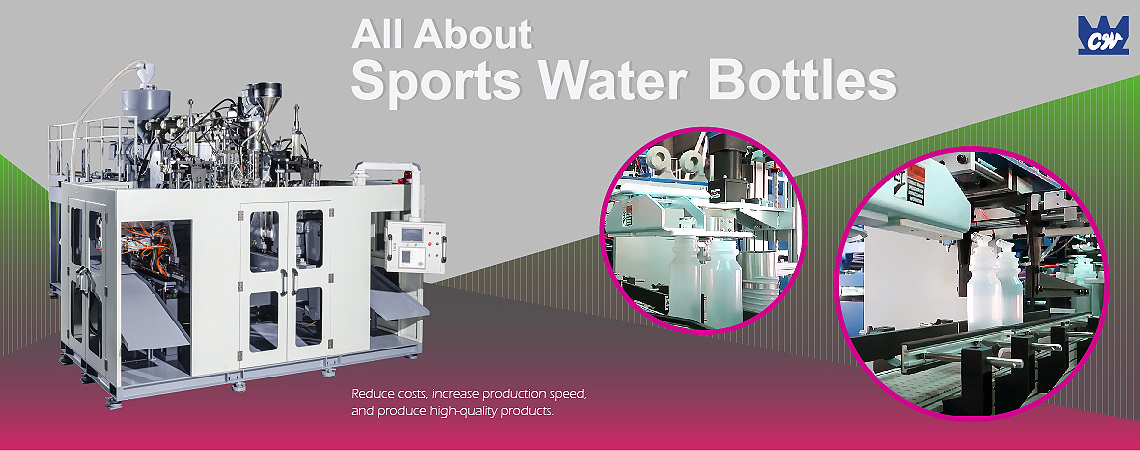
Applications of Extrusion Blow Molding in Sports Water Bottle Manufacturing
With the rise of environmental awareness, reusable sports water bottles have become a market mainstream because they combine environmental friendliness, practicality, and design appeal. To meet the demand for high-quality, durable, and diversely shaped products, global enterprises continue to invest in extrusion blow molding equipment for sports water bottles. This not only strengthens brand image but also effectively drives sales growth and revenue increases.
How are sports water bottles manufactured through extrusion blow molding?
Sports water bottles are manufactured via extrusion blow molding, where molten plastic is extruded into a tube-like parison, placed into a mold cavity, and blown into shape, with the finished product retrieved after cooling. This process is ideal for mass production, ensuring dimensional stability and uniform structure while effectively balancing efficiency and cost control.
Which plastic materials are commonly used in sports water bottle blow molding?
Extrusion blow molding can process a wide variety of plastic materials, making it particularly suitable for sports water bottles that require a balance of lightweight properties, durability, and safety.
Low-Density Polyethylene (LDPE) is one of the most used materials, offering flexibility, excellent toughness, impact resistance, and good sealing capabilities. It can present a transparent or translucent appearance, making it perfect for squeezable water bottles; its low density and light weight also facilitate transportation and use. Depending on product design requirements, HDPE or PP can also be selected to enhance rigidity, chemical resistance, or surface texture, thereby satisfying different market positionings.
Key Advantages of Sports Water Bottle Extrusion Blow Molding Machines
To meet the quality and efficiency demands of sports water bottle production, highly efficient and flexible extrusion blow molding equipment has become mainstream. Its customized configurations can be adjusted according to production needs to enhance overall manufacturing flexibility. Common features include:
1. Single-station or double-station configurations to flexibly respond to capacity demands.
2. View-stripe extrusion unit, making it convenient to observe the liquid level.
3. Automatic deflashing unit to improve production line efficiency.
4. Integrated In-Mold Labeling (IML) system to achieve permanent labeling and cosmetic decoration.
5. Blow molding with anti-slip materials to increase grip performance.
6. Rotary cutting device to remove scrap material at the bottle neck, making the appearance smoother and more aesthetically pleasing.
7. Multiple automation options to build a high-efficiency production line with low labor requirements.
Specialized sports water bottle blow molding machines can stably produce FDA/RoHS-compliant and BPA-free water bottles, helping brands quickly respond to changes in market and design demands. High-quality equipment enhances capacity and stability, creating long-term value for enterprises in a competitive market.
- Video
Over 35 years of expertise in blow molding equipment make us the preferred choice for long-term partners.
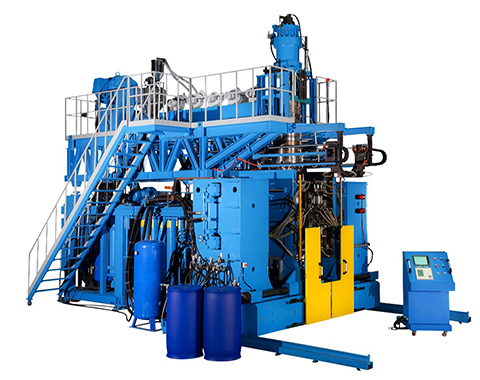
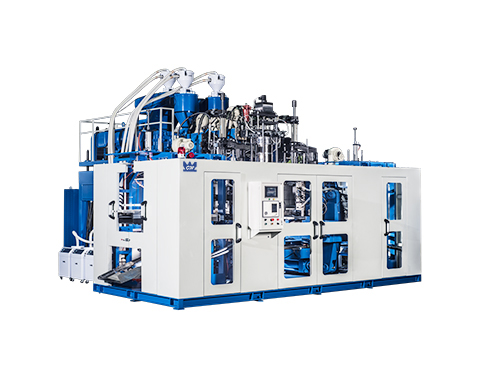
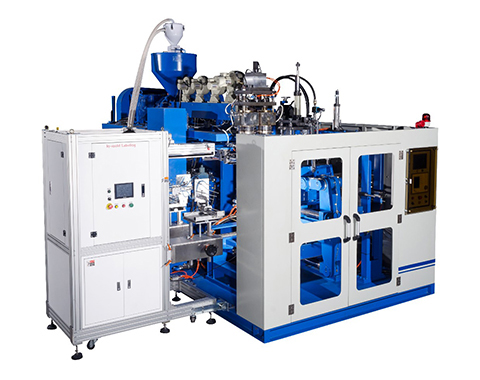
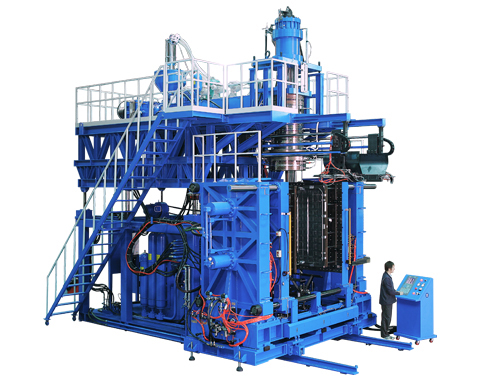
Machine Features for Sports Bottle Production
Sports water bottles are made by extruding a parison, closing the mold around it and blowing it to shape, a process suited to mass production with stable dimensions. LDPE is widely used for squeezable bottles because it is flexible, tough and seals well; HDPE or PP are chosen when the design needs more rigidity, chemical resistance or a different surface.
Machine features follow the product specification: single or double stations for capacity, a view stripe extruder, automatic deflashing, in-mold labeling, anti-slip material for grip, and a rotary cutting device that trims scrap at the bottle neck. A 1 L double-cavity, double-station machine with neck rotation and cutting is shown in on-site testing. The under 5 L continuous machine covers bottles of this size; send your bottle design and output target with your inquiry to request a configuration.